Text messaging is an integral part of daily life. The average American checks their phone around 205 times per day, and 76% look almost immediately after receiving a notification. Rather than trying to steal your audience’s attention away from their phones, your nonprofit should use this opportunity to reach donors where they’re already spending most of their time.
By developing a nonprofit text messaging strategy, you can send updates, appeals, and reminders to keep your mission at the top of supporters’ minds. In this guide, we’ll walk you through everything your nonprofit needs to know to make the most of this highly engaging communication channel. Specifically, we’ll cover:
- Nonprofits Text Messaging FAQs
- How to Leverage Text Messaging for Nonprofits
- How to Launch a Nonprofit Text Messaging Strategy
- Nonprofit Text Messaging Best Practices
- The Best Texting Service for Nonprofits: Tatango
By learning how to leverage SMS for nonprofits in your fundraising and marketing strategies, you’ll expand your reach and revenue in no time.
Nonprofit Text Messaging FAQs
Before we jump into how your nonprofit can get started with text messaging, let’s review a few frequently asked questions.
Can nonprofits send text messages?
Yes, nonprofits can send text messages to any supporter who opts in.
Many organizations use SMS (short message service) to communicate quickly with donors, volunteers, program participants, and more. With a nonprofit text messaging service and a robust contacts list, you can send personalized messages at any time to promote fundraisers, raise awareness, and further your mission. Supporters can even text back to start one-to-one conversations that deepen their relationship with your organization.
Why use nonprofit text messaging?
Unlike emails or direct mail, text messaging is a familiar, friendly, and fast channel that many donors are more than happy to engage with. The most notable benefits of nonprofit text messaging include:
- High open rate: Subscribers who receive text messages from organizations they support open them 99% of the time. That’s four times higher than the open rate of email marketing messages, which is only 22%.
- High read rate: 90% of supporters open your messages within just three minutes of receiving them. Compare that to social media, where even your most loyal supporters may never see your latest posts due to ever-changing algorithms and online noise.
- Personalization: Your nonprofit can use segmentation tools to target specific audiences and deliver a more authentic, one-on-one communication experience. Encourage two-way communication by inviting feedback, conducting surveys, or holding Q&A sessions via text.
- Maximized reach: The right text messaging platform will enable your nonprofit to mass-send text messages with a single click. These bulk texts allow you to engage individual supporters with tailored, relevant content without draining your already-limited staff resources.
- Automation: Many text marketing platforms allow you to schedule messages and set up auto-responses. For example, you might automatically send welcome texts to new contacts as soon as they opt in and thank-you notes to donors right after they give. These cutting-edge tools save you time and energy so you can focus on other mission-related priorities.
Is text messaging worth it for nonprofits?
Yes! Nonprofit text messaging has proven ROI, especially when your strategy includes both fundraising and engagement texts.
In our 2025 Nonprofit Texting Insights Report, we analyzed more than 138 million texts and found that nonprofits raised $4.38 for every dollar spent on fundraising texts and $3.03 for engagement texts. During year-end giving season, texting ROI jumped by 89%. Clearly, text messaging for nonprofits is well worth the investment.
Is mass text messaging legal for nonprofits?
Yes, mass texting is legal for nonprofits as long as they comply with regulations like the Telephone Consumer Protection Act (TCPA). This means you must obtain supporters’ express consent before texting them, provide an easy way to opt out, and always clearly identify your organization.
You must also register your nonprofit’s phone number with wireless carriers, but text messaging services for nonprofits like Tatango can take care of that process for you.
How to Leverage Text Messaging for Nonprofits
Your nonprofit can leverage SMS to enhance nearly any initiative or project. Check out a few of the most common and effective ways nonprofits use text messaging:
Raise Funds
Text messages can prompt immediate responses from your donors, making them ideal for urgent donation appeals, GivingTuesday campaigns, and peer-to-peer fundraising. Thanks to text fundraising tools, all donors have to do is click on your donation page link to make one-time or recurring donations straight from their phones.
Steward Donor Relationships
When donors give, they want to know that their dollars are making a meaningful change in their community, so transparency is key. Text messaging provides a quick and engaging way to thank donors, provide updates on their gifts’ impact, and ask for feedback to improve their giving experience.
Boost Event Engagement

Use text messages to market upcoming events, send reminders to registrants, communicate updates as needed, and thank attendees afterward. During events, you can also use texting to engage attendees with live polls or Q&A sessions. March of Dimes, for instance, uses text marketing to boost participation during its March for Babies walk-a-thon every year.
Share Important Announcements
The speed of SMS makes it the perfect channel for getting the word out fast. You can use texts to spread awareness of important news related to your cause, send emergency announcements to donors, and tell supporters how they can get involved in your latest advocacy activities.
Manage Volunteers
Through text messaging, you can broadcast open volunteer roles, share links to your volunteer registration page, and follow up with prompt thank-you messages. Once a volunteer shift approaches, you can even use one-to-one texts to share personalized reminders and updates. Share location details and respond to volunteers’ questions in real time.
Collect Signatures
You can encourage more people to participate in your advocacy activities by sharing petitions via SMS. By clicking on your petition link, supporters can immediately add their signatures and make their voices heard.
How to Launch a Nonprofit Text Messaging Strategy
If you’re ready to start tapping into the benefits and uses of text messaging for nonprofits, follow these key steps.
1. Choose a texting service for nonprofits.
Equip your nonprofit with all the SMS tools and features you need by looking for software providers that offer:
- A2P (Application to Person) messaging. A2P messaging allows your nonprofit to mass send messages and reach all your supporters at once. This way, you’ll never have to worry about accidentally leaving anyone out of your important communications.
- Fast messaging speeds. A provider with a slow messages-per-second rate can delay your texts by hours, which isn’t ideal when working with urgent deadlines. Choose a platform that enables you to reach thousands of recipients per second after sending.
- Subscriber segmentation. Personalizing your text messages increases the chances that donors will read and respond to them. Ensure that your provider has robust segmentation capabilities so you can categorize your subscribers by location, recency of opting in, donation frequency, and more.
- Data security. If a data leak occurs, an unauthorized user can gain access to your entire contacts list or send out messages posing as your nonprofit. This can disrupt your campaigns and reduce donor trust. To avoid this, work with a software provider that offers two-factor authentication, secure sending, and automated logout to protect.
The most effective nonprofit text messaging platforms will provide all these features and more to deliver a user-friendly texting experience for both your team and supporters.
2. Build your subscriber list.
The TCPA protects consumers from unsolicited communications, meaning you can only text supporters who have explicitly opted in to receiving text messages from your organization. To stay compliant and avoid hefty fines, you should:
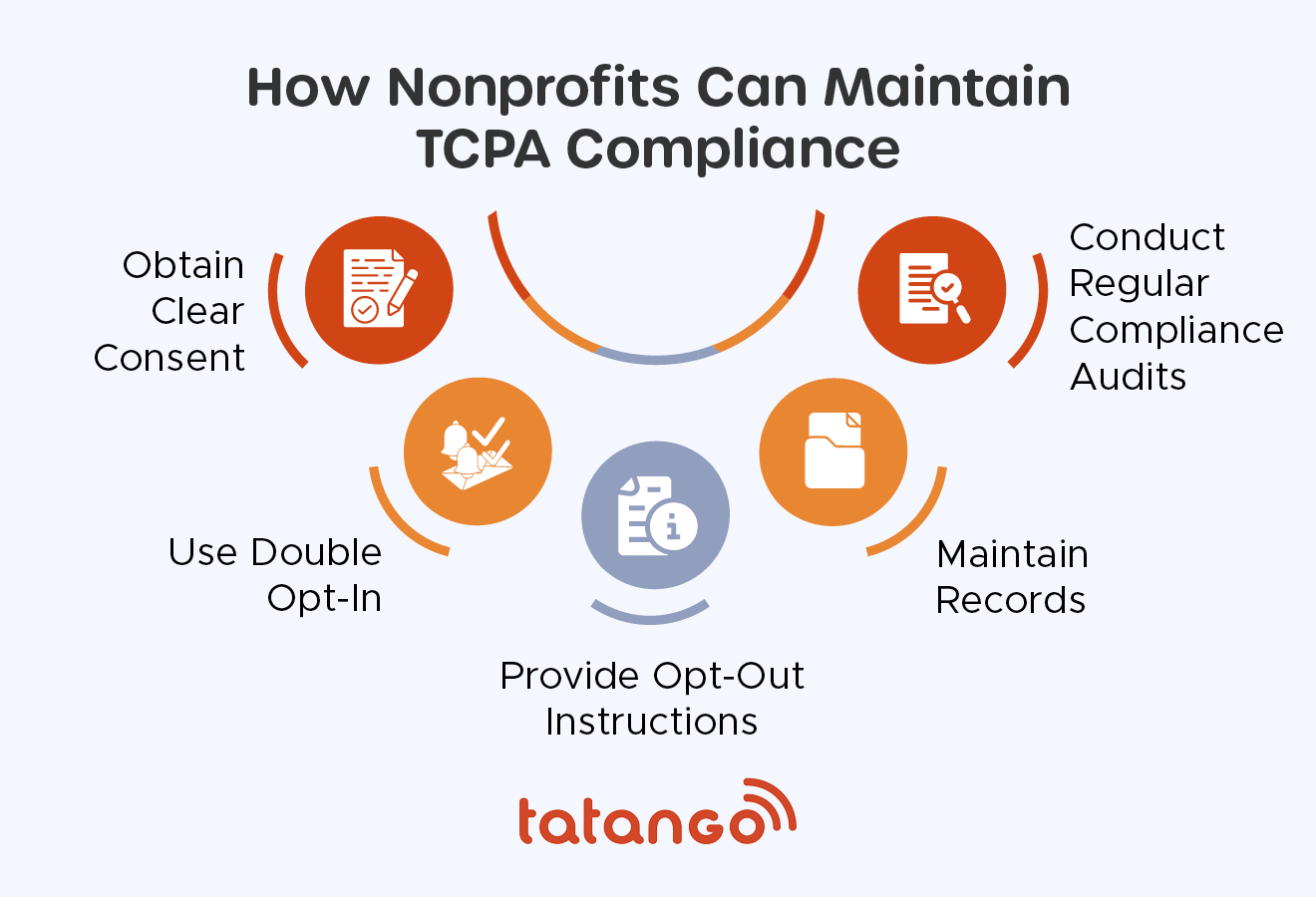
- Obtain clear consent in the form of a written opt-in.
- Use double opt-in by sending confirmation texts when supporters sign up for texts.
- Provide opt-out instructions in every message, such as “STOP2END.”
- Maintain records of which contacts have given their consent to receive texts.
- Conduct regular compliance audits to ensure you’re following all guidelines.
Most importantly, you need to build a robust contact list of opted-in supporters. Start by asking your existing supporters to opt in, whether via email, a form on your website, a checkbox on your donation page, or a QR code on physical marketing materials. Donors can give their consent to receive texts through any of these methods.
Additionally, supporters can text a keyword to your nonprofit’s short code to opt in at any time. To promote this option, share messages on social media and other marketing channels that read, “Text JOIN to 55555 to join our text list!”
3. Start sending messages & tracking KPIs.
Once you have supporters’ consent, you can start texting! Create a strategy that includes both fundraising and engagement texts, then draft some initial messages to test with your audience.
With the right software, you can create robust reports for each text message to analyze its success. Track your results and unlock powerful insights to improve your campaign by following these steps:
- A/B test two versions of the same text message to find out which one resonates most with your recipients.
- Compare open rates with click-through rates (CTR) to gauge the interest in links containing time-sensitive information.
- Analyze SMS conversion rates and compare them with other channels like email and social media.
- Track the number of donations along with the total and average amount raised from each fundraising message.
- Pay attention to fluctuations in your subscriber list, including the number of opt-out requests you receive each time you send a message.
Here’s what several of these metrics look like within Tatango’s platform:

Text messaging analytics help you refine your strategies to drive greater engagement. Use these metrics to determine whether you need to modify the language, length, timing, CTAs, or other factors in your next text message.
Nonprofit Text Messaging Best Practices
Use these best practices to inspire more supporters to get involved through text messaging:
Include one call to action per message.
Ask your supporters to take one action per message, whether that’s donating, registering for an event, or signing up to volunteer. For example, if you’re seeking donations, explain how you’ll use the funds, ask for a certain donation amount, and share a mobile-friendly donation link so donors can give right from their phones.

Use deadlines and goals to add urgency to your CTAs. Phrases like “Donate by Friday to have your gift matched!” and “Register by June 30th!” encourage supporters to take immediate action to support your nonprofit.
Use eye-catching images.
Humans understand images 60,000 times faster than text. Eye-catching images are a great way to grab your subscribers’ attention or communicate a message best conveyed visually.
For instance, capture your supporters’ hearts by showcasing exactly who their gift will help. If your nonprofit’s mission focuses on healing children, include images that show children who have benefitted from your work. Emphasize that your services would not be possible without the generous support of donors.

Optimize your donation page.
To run a successful text-to-give campaign, ensure that your nonprofit’s donation page is mobile-friendly. This way, when donors click the donation page link in your text message, they can easily fill out your form without experiencing any technical issues.
Streamline the giving process by only requesting donors’ contact information, donation amount, and billing information. You can always collect more donor details as you build relationships with them over time.
Personalize your nonprofit’s text messages.
By segmenting your texts, your nonprofit can tap into your supporters’ unique giving motivations and make them feel valued. This will help you build stronger relationships and encourage supporters to stay subscribed.
With automation tools, you can address your subscribers by name to help them feel connected to your cause. Supporters are much more likely to act on a text that’s uniquely addressed to them as opposed to a generic greeting such as “Hi Donor.”
Focus on storytelling.
Your nonprofit’s work touches the lives of many people every day, from beneficiaries to volunteers. Share these impactful stories to help potential and current supporters feel more emotionally connected to your cause. For instance, a career readiness nonprofit might explain how one beneficiary landed their dream job after participating in the organization’s resume-building and interviewing workshops.
Remember to ask for permission before sharing someone’s name, image, and story. Doing so builds more trust in your audience, demonstrating that your nonprofit respects people’s privacy and comfort.
Communicate at the right frequency.
Your text messaging cadence and frequency will depend on what your organization is trying to promote. For example, if your nonprofit participates in GivingTuesday, you’ll need to send several texts throughout the day to create urgency and encourage giving before the day is over. However, if you’re simply promoting your annual fundraising campaign, you may send only a few messages each month to keep people engaged.
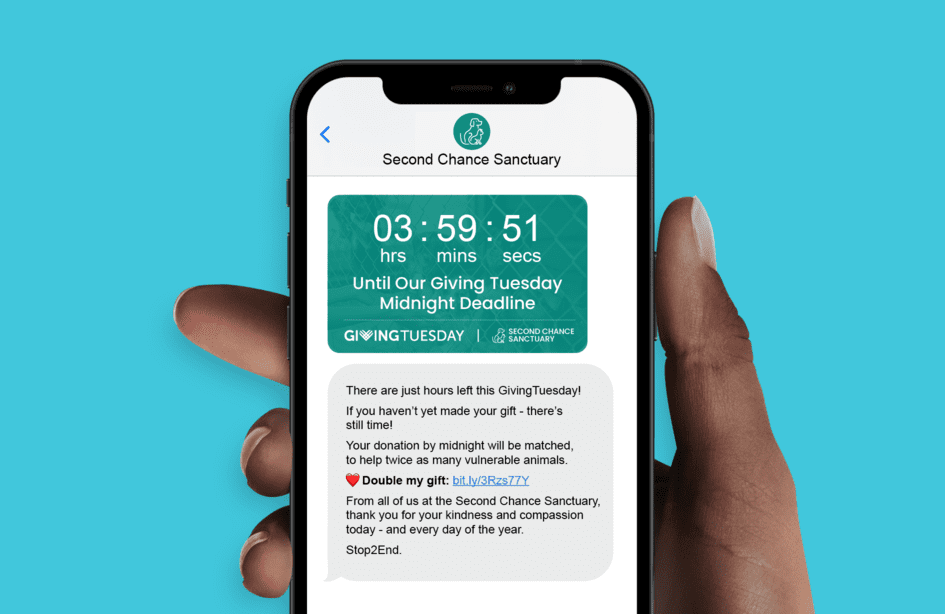
Remember that your nonprofit shouldn’t only be sending donation appeals. Diversify your texts and strengthen relationships with your supporters by sharing updates about your latest projects, the results of your recent fundraising campaign, and upcoming events.
Use a multichannel approach.
Your nonprofit’s audience has varying communication preferences. Text messaging is a fast and reliable way to reach supporters, but it shouldn’t make up your entire marketing strategy. Maximize your reach by using text messages alongside emails, social media posts, and direct mail.
For example, let’s say your organization is trying to meet its GivingTuesday fundraising goal. You might first send an email explaining your campaign’s purpose and how you’ll use the funds. If you’ve secured a GivingTuesday donation match from a corporate sponsor, you’ll include these details in the email as well. Then, follow up with quick text reminders before and during GivingTuesday to maximize awareness, create a sense of urgency, and inspire more giving.

The Best Texting Service for Nonprofits: Tatango
To find success with your new SMS strategy, it’s essential to use a text messaging platform that allows you to easily send mass messages, track KPIs, and effortlessly sync your texting data across your nonprofit’s key tools and software. Your service provider should also have a proven track record of working with nonprofits, like we do at Tatango.
Tatango is the leading text messaging service for nonprofits of all types and sizes. With its comprehensive functionality, Tatango has helped nonprofits raise over $650 million and meet or exceed their fundraising goals.
From simple mass texting capabilities to intuitive messaging reports to track your results, Tatango provides a unique one-on-one communication experience that drives donor engagement. With a rate of 2,000 messages per second, Tatango has the bandwidth to reliably communicate with supporters, especially around time-sensitive deadlines.
Contact our team of experts today to start building text messaging strategies that inspire supporters to take action.
More Nonprofit Text Messaging Resources
Eager to learn more? Explore these additional resources for more tips and best practices on nonprofit text messaging:
- SMS Short Codes for Nonprofits: How to Get Your Own. Learn more about the benefits of SMS short codes and how to receive one from a nonprofit text messaging provider.
- 21 Text Donation Messages: Examples + Easy Templates. Check out these inspiring text message examples so you can strengthen your donation appeals and make a compelling case for your organization.
- Text Fundraising: More Than Text-to-Give vs Text-to-Donate. Confused about nonprofit texting terminology? Get clarification here and learn about the modern approach to SMS.
 Mike Snusz, Director of Nonprofit Customer Experience
Mike Snusz brings nearly two decades of digital fundraising expertise to his role as Director of Nonprofit Customer Experience at Tatango, the industry’s leading text messaging platform for nonprofits. A recognized thought leader in SMS fundraising, Mike regularly speaks at national conferences and contributes insights to resources like the Texting Insights Report and other nonprofit publications.
Before joining Tatango, Mike spent 15 years at Blackbaud, where he led a team of digital consultants helping nonprofits optimize their online giving, email marketing, peer-to-peer fundraising, and monthly giving programs.
He began his nonprofit career in Buffalo, NY, managing the Ride For Roswell from 2003 to 2005—an experience that continues to shape his commitment to helping mission-driven organizations thrive in a digital world.